
Philosophy Matters - The Incredible Hegel

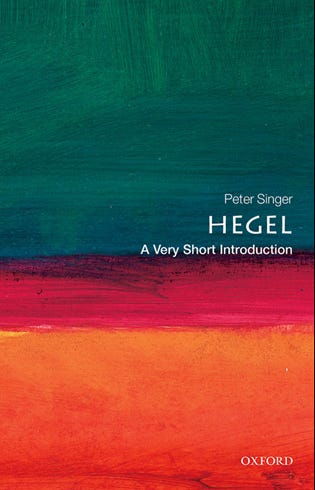
Hegel: A Very Short Introduction by Peter Singer
I am reading Hegel because I am interested in understanding Marx. And I am interested in understanding Marx because Marxism has shown that it is still a “live option” in the election of Zohran Mamdani as Mayor of New York tonight (November 4, 2025). Mamdani was elected on both the Democratic and Democratic Socialists of America (DSA) lines. The DSA is quite open about the fact that its membership and constituent organizations include both Marxists and Communists. Marxism should have died with the collapse of the Soviet Union, but to true believers, this time it will work for sure.
I don’t think Marx can be understood without some understanding of Hegel. Marx was a “Young Hegelian.” Marx’s dialectical materialism adopted Hegel’s dialectical style of philosophy, particularly with its obsession with history. Marxism is also ultimately mystical in its appeal to history as a trans-human force that moves progressively to the eschaton. This mysticism is found in Hegel, who posited a “World Spirit” that somehow moves history progressively through higher states of being until it can realize itself in freedom. [1]
As part of this project, I’ve read Charles Taylor’s “Hegel and Modern Society” and Peter Singer’s “Hegel: A Very Short Introduction.” The Singer book is shorter and more accessible. Singer is a well-known Utilitarian philosopher who holds a variety of controversial positions. Notwithstanding his reputation, his presentation of Hegel is very well done, gradually leading the reader into the more difficult and abstract parts of Hegelian philosophy. He also reduces Hegel’s abstract terminology into ideas that remove the strangeness and make the ideas relatable.
Singer begins with a biography of George William Friedrich Hegel (1770-1830).[2] Hegel was in his early twenties when the French Revolution gave birth to the Terror, and in his thirties when French armies under Napoleon overwhelmed Prussia. Hegel lived in the golden age of German literature. “He was a close friend of the poet Hölderlin, and a contemporary of the leaders of the German Romantic movement, including Novalis, Herder, Schleiermacher, and the Schlegel brothers. Goethe and Schiller were major influences on Hegel, and he was obviously taken with some of the Romantic movement’s ideas, though he rejected most of what the Romantics stood for.” (p. 4) Hegel was also close friends with Friedrich Schelling, who later claimed that Hegel had plagiarized him. (p. 6.)
Along with being hard to read, Hegel’s lecture style did not commend itself. According to Singer:
He was not a good lecturer in the conventional sense, but he clearly captivated his students. Here is a description by one of them:
I was unable at first to find my way into either the manner of his delivery or the train of his thought. Exhausted, morose, he sat there as if collapsed into himself, his head bent down, and while speaking kept turning pages and searching in his folio notebooks, forward and backward, high and low. His constant clearing of his throat and coughing interrupted any flow of speech. Every sentence stood alone and came out with effort, cut in pieces and jumbled … Eloquence that flows along smoothly presupposes that the speaker is finished with the subject inside and out and has it by heart … this man, however, had to raise up the most powerful thoughts from the deepest ground of things … a more vivid representation of these difficulties and this immense trouble than was accomplished by the manner of his delivery would be inconceivable.
Singer, Peter. Hegel: A Very Short Introduction (Very Short Introductions Book 49) (pp. 11-12). OUP Oxford. Kindle Edition.
Immanuel Kant had come close to finishing off the Enlightenment philosophical project, but, according to Singer, his philosophy was unsatisfying for two reasons. First, Kant’s view that humans were limited to knowing phenomena – how things appear – and not noumena – things in themselves (or “das ding an sich,” the “thing-in-itself”) – was viewed as unduly limiting the powers of human reason. The second was the division of human nature implied by Kant’s philosophy into reason and passion was seen as “degrading and defeatist,” particularly since it gave passion no role in moral philosophy.
Singer begins his review of Hegel’s philosophy where it is easiest, i.e., with his philosophy of history. This aspect of Hegelianism was particularly noteworthy to Marx and Engels:
This notion of change, of development throughout history, is fundamental to Hegel’s view of the world. Friedrich Engels, looking back on Hegel’s importance to himself and to his colleague Karl Marx, wrote: What distinguished Hegel’s mode of thinking from that of all other philosophers was the exceptional historical sense underlying it. However abstract and idealist the form employed, the development of his ideas runs always parallel to the development of world history, and the latter is indeed supposed to be only the proof of the former.
Singer, Peter. Hegel: A Very Short Introduction (Very Short Introductions Book 49) (p. 13). OUP Oxford. Kindle Edition.
Hegel’s Philosophy of History is written to demonstrate the premise that history progresses toward freedom. In the earliest cultures, Kings were gods, and then the aristocracy developed to share the freedom. In Greece, there was a notion of freedom for Greek citizens, who still held slaves and viewed their polity as a matter of tradition, rather than reason. The Protestant Reformation gave rise to the idea of individual conscience determining religious beliefs. The French Revolution sought to eliminate the irrational structures of the past in the interest of democratic freedom, but was unable to replace what it erased with anything constructive. Ultimately, the pinnacle of human civilization emerged with the Prussian monarchy. (Joking….but the Prussian state was darn close.)[3]
History moves toward a goal. Singer explains:
Hegel’s account of world history has now reached his own times, and so it comes to an end. He concludes by repeating (in slightly different words) the theme he introduced at the start of it all – ‘the history of the world is nothing but the development of the idea of freedom’ – and suggesting that the progress of the idea of freedom has now reached its consummation. What was required was both that individuals should govern themselves according to their own conscience and convictions, and also that the objective world, that is the real world with all its social and political institutions, should be rationally organized. It would not be sufficient to have individuals governing themselves according to their own conscience and convictions. This would be only ‘subjective freedom’. As long as the objective world was not rationally organized, individuals acting in accordance with their own conscience would come into conflict with its law and morality. Existing law and morality would therefore be something opposed to them, and a limit upon their freedom. Once the objective world is rationally organized, on the other hand, individuals following their consciences will freely choose to act in accordance with the law and morality of the objective world. Then freedom will exist on both the subjective and the objective level. There will be no restrictions on freedom, for there will be perfect harmony between the free choices of individuals and the needs of society as a whole. The idea of freedom will have become a reality and the history of the world will have achieved its goal.
Singer, Peter. Hegel: A Very Short Introduction (Very Short Introductions Book 49) (pp. 29-31). OUP Oxford. Kindle Edition.
According to Hegel, history is nothing but the progress of the consciousness of freedom. [4]
To anyone acquainted with Marxism, the overlay onto the utopia of the classless state seems obvious.
After discussing Hegel’s history of philosophy, Singer discusses Hegel’s Philosophy of Right (or Law), which includes Hegel’s discussion of “freedom.” The difficulty here will be that moderns have a different understanding of “freedom” than Hegel (or St. Augustine) had. For moderns, “freedom” means an absence of restriction. It means the ability to choose between options. This is what Isaiah Berlin called “negative freedom” and Hegel called “absolute freedom.” Hegel’s (and Kant’s) view of freedom was that people are not free unless they are free from external influences, which means that they are acting pursuant to their pure reason. A liberal using the “negative freedom” definition would say that a person is free when they can choose between options, such as brands of deodorant. An adherent to the second kind of freedom – a radical economist – would say that the decision to choose a deodorant is itself not free if it is based on an artificially created desire, a desire created by advertising. [5] Singer writes:
There is a clear parallel between this debate and Hegel’s debate with those who define freedom as the ability to do what we please. This negative concept of freedom is like the liberal economist’s conception of a good economic system: it refuses to ask what influences form the ‘pleasings’ that we act upon when we are free to do as we please. Those who hold this conception of freedom assert that to ask such a question, and to use the answers as a basis for sorting out genuinely free choices from those that are free only in form and not in substance, would be to write one’s own values into the conception of freedom. Hegel’s retort, like that of the radical economists, would be that the negative conception of freedom is already based on a value, the value of action based on choice, no matter how that choice is reached or how arbitrary it may be. The negative conception of freedom, in other words, gives its blessing to whatever circumstances happen to be influencing the way people choose.
Singer, Peter. Hegel: A Very Short Introduction (Very Short Introductions Book 49) (p. 37). OUP Oxford. Kindle Edition.
Choosing based on desires is problematic. Many of our desires are artificially shaped by our upbringing, society, education, or advertising. Since we do not choose our desires, we are not free when we act from desire. Kant proposed as an alternative that a person act in accordance with reason, which is universal. A free decision is one that seeks to act in accord with the universal law of reason and morality; it involves doing something because it is one’s duty, not because one desires it. This is daunting, but Singer makes it palatable by pointing out: “To put his point in a way that modern readers might be readier to accept: freedom consists in following one’s conscience.”
Hegel accepted Kant’s idea that doing our duty for its own sake is a “notable advance on the negative idea of freedom as doing what we please.” However, he attacks Kant on two grounds. First, he argued that Kant’s theory was empty; it doesn’t say what reason should dictate. Categorical imperatives and non-contradiction can be universalized in ways that don’t accord with our intuitions. For example, we might think that a law against theft follows the categorical imperative, but a Communist might not see that such a law had merit since they might not accept the idea of private property.
Kant’s second objection to Kant was that Kant’s philosophy divides “man against himself, locks reason into eternal conflict with desire, and denies the natural side of man any right to satisfaction.” Kant does not answer the question of “Why should I be moral?”
Hegel’s answer is to find the “unity of individual satisfaction and freedom in conformity to the social ethos of an organic community.” Aristotle noted that the family is prior to the individual. People are born into families, and they are shaped by their families before they can consciously reason. Singer quotes the British philosopher F.H. Bradley as providing a similar explanation for the organic community. A child is born into a living world and does not think of himself as a separate self without socialization. The child’s needs and desires are shaped by the society, the organic community he was born into. If this organic community were based on reason, it would end the conflict between individual and community interests. [6]
This may be why revolutions turn into tyrannies; they disrupt the organic community and don’t replace it with something that naturally developed. Singer writes:
In the Philosophy of History, we saw what happened when people first ventured to strike down irrational institutions and build a new state based on purely rational principles. The leaders of the French Revolution understood reason in a purely abstract and universal sense which would not tolerate the natural dispositions of the community. The Revolution was the political embodiment of the mistake Kant made in his purely abstract and universal conception of duty, which would not tolerate the natural side of human beings. In keeping with this pure rationalism the monarchy was abolished, and all other degrees of nobility as well. Christianity was replaced by the cult of Reason, and the old system of weights and measures abolished to make way for the more rational metric system. Even the calendar was reformed. The result was the Terror, in which the bare universal comes into conflict with the individual and negates him – or, to put it in less Hegelian terms, the state sees individuals as its enemies and puts them to death.
Singer, Peter. Hegel: A Very Short Introduction (Very Short Introductions Book 49) (p. 48). OUP Oxford. Kindle Edition.
Hegel’s philosophy has left him open to charges of being variously a totalitarian (according to Karl Popper), a conservative, and a liberal. Hegel had occasions where he seemed to describe the State as “divine.” [7] However, these quotes were balanced by writings that tended to mute the totalitarian implications of these statements. Putting aside what Hegel thought, it may be fair to say that there is enough in Hegel to justify a variety of positions. [8]
After freedom, Singer moves to Hegel’s metaphysics. He introduces this subject in this winsome way:
It is time to confess: I have been cheating. My account of Hegel’s philosophy so far has carefully omitted all mention of something that Hegel himself refers to repeatedly and regards as crucial: the idea of Geist.
Singer, Peter. Hegel: A Very Short Introduction (Very Short Introductions Book 49) (p. 60). OUP Oxford. Kindle Edition.
It is probably here that, for modern readers, the train derails. Hegel’s philosophy is premised on the idea that reality is ultimately “Mind.” Hegel called the Mind substrate the “Weltgeist” or “World Soul.” Singer opts for “Mind” over “World Soul” because of the religious connotations of “soul,” but he acknowledges that either word might be applicable.
Hegel was dealing with the division Kant made between phenomena—the things we can perceive—and the noumena—things in themselves. Hegel wrote “The Phenomenology of Mind,” which is the study of how the mind appears to itself. The goal is to determine what is true from what the mind perceives.
Hegel employs his dialectical process in this investigation. He starts with “sense-certainty,” i.e., the thing that the senses perceive, but this knowledge is inadequate because all that can be known from the senses is that there is a “this” that is “here.” Anything more requires categorization beyond the senses, for example, “red” or “apple.” This kind of categorization involves a universal, which requires abstraction and reason. Thus, Hegel is forced to move up to a higher level to find knowledge, which he finds in “self-consciousness,” but self-consciousness cannot exist in isolation. If the universe were composed only of a self-conscious being, how would it know that? It must define itself in opposition to something that is not itself, and presumably, this is another self-conscious being.
This leads to Hegel’s master-slave dialectic. If there are two self-conscious being in opposition, then one will be superior (Master) and one will be inferior (slave.) This slave serves the master. This seems to be satisfactory for the master, but it is the slave who becomes more aware of his own consciousness since he can see it in the fruits of his labor. [9]
The slave develops Stoicism, but he problem is that Stoicism is cut off from the real world. The next step is religion, which Hegel calls the “unhappy consciousness.” Singer explains:
‘The unhappy consciousness’ is clearly a form of consciousness that existed under Christianity. Hegel also refers to it as ‘the alienated soul’, and this expression provides a better clue to what Hegel has in mind. In the alienated soul, the dualism of master and slave is concentrated into one consciousness, but the two elements are not unified. The unhappy consciousness aspires to be independent of the material world, to resemble God and be eternal and purely spiritual; yet at the same time it recognizes that it is a part of the material world, that its physical desires and its pains and pleasures are real and inescapable. As a result the unhappy consciousness is divided against itself. This conception should be familiar from the discussion of Hegel’s attitude to Kant’s ethics in the preceding chapter; on this occasion, it is Christianity rather than Kant that Hegel has in mind. Recall St Paul’s ‘The good which I want to do I fail to do; but what I do is the wrong which is against my will’, and St Augustine’s plea: ‘Give me chastity and continence, but do not give it yet.’
Hegel’s target is any religion which divides human nature against itself – and he asserts that this is the upshot of any religion which separates man from God, putting God in a ‘beyond’ outside the human world. This conception of God, he maintains, is really a projection of one aspect of human nature. What the unhappy consciousness does not realize is that the spiritual qualities of God which it worships are in fact qualities of its own self. It is in this sense that the unhappy consciousness is an alienated soul: it has projected its own essential nature into a place for ever out of its reach, and one which makes the real world in which it lives seem, by contrast, miserable and insignificant.
Singer, Peter. Hegel: A Very Short Introduction (Very Short Introductions Book 49) (p. 84). OUP Oxford. Kindle Edition.
Marx would use this idea as a basis for attacking religion.[10]
Part of Hegel’s idea of the “World Soul” was that the World Soul was Reason, and reason is found in every human being. Singer explains:
We also saw that Hegel regards reason as inherently universal. If reason is the essential medium of mind, it follows that mind is inherently universal. The particular minds of individual human beings are linked because they share a common universal reason. Hegel would put this even more strongly: the particular minds of individual human beings are aspects of something inherently universal, namely mind itself. The greatest obstacle to the rational ordering of the world is simply that individual human beings do not realize that their minds are part of this universal mind. Mind progresses towards freedom by chipping away at this obstacle. Remember how at the very beginning of the Phenomenology consciousness was limited to knowledge of the bare particular ‘this’, and was compelled to accept the universal terms implicit in language. From that point on, every step has been a step along a winding road that leads towards a mind closer to conceiving of itself as something both rational and universal. This is the road to freedom, because individual human minds cannot find freedom in rational choice when they are locked into conceptions of themselves that do not acknowledge the power of reason or its inherently universal nature.
Singer, Peter. Hegel: A Very Short Introduction (Very Short Introductions Book 49) (p. 89). OUP Oxford. Kindle Edition.
In every case discussed by Hegel, knowledge has to go beyond itself, e.g., sense-perception had to go beyond itself to universals, and self-consciousness required a second self-consciousness.
According to Hegel, Reason/Mind/World Soul has been at work throughout history, shaping events so that it can finally become aware of itself. The answer to the phenomenology of mind is that Mind has been constructing the world through ideas and bringing those ideas into existence through humanity. Self-consciousness has been evolving. At some point, self-consciousness need not go beyond itself, namely, when it becomes aware of itself as creating reality. Singer writes:
Hegel believes, then, that the ultimate reality is mind, not matter. He also believes that the Phenomenology has led to this conclusion. From the stage of sense-certainty onwards, every attempt to gain knowledge of an objective reality independent of mind failed. The raw information received by the senses proved meaningless until it was brought under a conceptual system produced by consciousness. Consciousness had to shape the world intellectually, to classify and order it, before knowledge was possible. So-called ‘material objects’ turned out to be not things existing quite independently of consciousness, but constructs of consciousness, involving concepts like ‘property’ and ‘substance’. At the level of self-consciousness, consciousness became aware of the laws of science as laws of its own creation, and so for the first time mind had itself as the object of its scrutiny. It was also at this stage that consciousness began to shape the world practically as well as intellectually, by taking material objects and working on them, fashioning them in accordance with its own images of how they should be. Self-consciousness then began to shape its social world too, a process culminating in the discovery that reason is sovereign over everything. In other words, although we set out merely to trace the path of mind as it comes to know reality, at the end of the road we find that we have been watching mind as it constructs reality.
Only on this conception of reality as the creation of mind can Hegel fulfil the undertaking he made in the introduction to the Phenomenology, to show that we can have genuine knowledge of reality. Remember how he poured scorn on all conceptions of knowledge as some kind of instrument for grasping reality, or as a medium through which we view reality. All these conceptions, he said, divide knowledge from reality. Kant, with his notion of the ‘thing-in-itself’ as for ever beyond knowledge, was obviously one of the targets of this criticism. In contrast, Hegel promised that the Phenomenology would reach a point ‘where knowledge is no longer compelled to go beyond itself’, where reality will no longer be an unknowable ‘beyond’, but instead mind will know reality directly and be at one with it. Now we can understand what all this meant: absolute knowledge is reached when mind realizes that what it seeks to know is itself. This point is the key to understanding the Phenomenology as a whole. It is probably the most profound of all the ideas of Hegel that I am attempting to convey in this book, so let us go over it again.
Reality is constituted by mind. At first mind does not realize this. It sees reality as something independent of it, even as something hostile or alien to it. During this period mind is estranged or alienated from its own creation. It tries to obtain knowledge of reality, but this knowledge is not genuine knowledge because mind does not recognize reality for what it is, and so regards it as a mysterious thing beyond its grasp. Only when mind awakens to the fact that reality is its own creation can it give up this reaching after the ‘beyond’. Then it understands that there is nothing beyond itself. Then it knows reality as directly and immediately as it knows itself. It is at one with it. As Hegel puts it in the concluding section of the Phenomenology, absolute knowledge is ‘mind knowing itself in the shape of mind’.
Singer, Peter. Hegel: A Very Short Introduction (Very Short Introductions Book 49) (pp. 91-93). OUP Oxford. Kindle Edition.
But when does this occur? Singer writes:
There is one feature of the design that your guide cannot resist pointing out. Ask yourself when absolute knowledge is achieved. The answer is, of course, that it is achieved as soon as mind understands that reality is its own creation and there is no ‘beyond’ for it to know. And when does this occur? Well, since this conception of reality is the upshot of Hegel’s Phenomenology, it must occur when Hegel’s own mind grasps the nature of the universe. On Hegel’s view, mind comes to its final resting-place when he, Hegel, understands the nature of reality. There can scarcely be a more momentous conclusion to a work of philosophy. The closing pages of The Phenomenology of Mind are no mere description of the culmination of all human history; they are that culmination.
Singer, Peter. Hegel: A Very Short Introduction (Very Short Introductions Book 49) (p. 93). OUP Oxford. Kindle Edition.
And that is an interesting place to end this review.
Singer repeatedly observes that Hegel’s philosophy is no longer credible for modern readers. We don’t buy the idea of a World Soul, and unless we are Communists, we are not likely to believe that there is a force guiding history. I think the reason for that is that while we don’t live in the world of High Romanticism that Hegel lived in. Ideas like the World Soul and the notion that everyone is part of it were part and parcel of Romantic poetry. We’ve retained some parts of High Romanticism, but not that part.
[1] I think that Hegel, in turn, was influenced by Romanticism, which was alive at the time, particularly in Jena, where Hegel had his initial academic posting.
[2] Hegel was born the same year as Beethoven and a year after Napoleon. These men were all in their early 20s when the French Revolution turned toxic.
In short, Beethoven was the perfect hero for his time. Born in 1770, he reached maturity just as the French Revolution was turning the world upside down. Like his almost exact contemporary Napoleon Bonaparte (born in 1769), he tore up the rule book and proved by example that careers really could be open to talents. Both men demonstrated that although the Revolution had failed to establish the reign of liberty, it did create a culture in which charisma was at a premium.
Blanning, Tim. The Romantic Revolution: A History (Modern Library Chronicles Series Book 34) (p. 102). Random House Publishing Group. Kindle Edition.
When Hegel says he saw Napoleon—“this ‘world soul’”—in Jena in 1806, he was 36 and Napoleon was 37.
[3] Hegel thinks that a constitutional monarchy is a rational community. However, the model of constitutional monarchy that Hegel posits – a passive king, a weak parliament, rational laws – is not exactly the Prussia he lived in.
[4] The obvious question raised by that mind-numbing sentence ought to be: “Whose consciousness?”
[5] This perspective is found in J.K. Galbraith, Vance Packard, and Marxists.
[6] Singer writes:
I have dealt swiftly with these details of Hegel’s rational community because to readers living in the twenty-first century his preferences can only seem quaint, and his arguments for them have often – though not always – been shown by subsequent experience to be erroneous. So far as Hegel’s conception of freedom is concerned, the particular institutional arrangements he prefers are not crucial. It should by now be clear that Hegel is not talking about freedom in the political sense in which popular sovereignty is an essential element of a free society. He is interested in freedom in a deeper, more metaphysical sense. Hegel’s concern is with freedom in the sense in which we are free when we are able to choose without being coerced either by other human beings or by our natural desires, or by social circumstances. As we have seen, Hegel believes such freedom can exist only when we choose rationally, and we choose rationally only when we choose in accordance with universal principles. If these choices are to bring us the satisfaction which is our due, the universal principles must be embodied in an organic community organized along rational lines. In such a community individual interests and the interests of the whole are in harmony. In choosing to do my duty I choose freely because I choose rationally, and I achieve my own fulfilment in serving the objective form of the universal, namely the state. Moreover – and here is the remedy for the second great defect in Kantian ethics – because the universal law is embodied in the concrete institutions of the state, it ceases to be abstract and empty. It prescribes to me the specific duties of my station and role in the community.
Singer, Peter. Hegel: A Very Short Introduction (Very Short Introductions Book 49) (pp. 53-54). OUP Oxford. Kindle Edition.
[7] Singer explains:
Popper’s case is not as strong as it seems. First, his quotations nearly all come not from Hegel’s own writings, but from notes of his lectures taken by students and published only after his death, by an editor who explained in his preface that he had done a certain amount of rewriting. Second, at least one of these resonant utterances is a mistranslation. Where Popper quotes ‘The State is the march of God through the world’, a more accurate translation would be: ‘It is the way of God with the world, that the State exists.’ This amounts to no more than the claim that the existence of states is in some sense part of a divine plan. Third, for Hegel ‘State’ does not mean simply ‘the government’ but refers to all social life. Thus he is not glorifying the government against the people, but referring to the community as a whole. Fourth, these quotations need to be balanced by others, for Hegel frequently presents one aspect of a subject in an extreme form before balancing it against another. Thus Hegel’s remarks on the state follow upon earlier passages in which he says: ‘the right of subjective freedom is the pivot and centre of the difference between antiquity and modern times’ and goes on to say that this right ‘in its infinity’ has become ‘the universal effective principle’ of the new form of civilization. Later, we find him saying: ‘What is of the utmost importance is that the law of reason should be shot through and through by the law of particular freedom …’. Moreover, Hegel insists that, ‘in view of the right of self-consciousness’, laws can have no binding force unless they are universally known. To hang the laws so high that no citizen can read them, as Dionysius the Tyrant is said to have done, or to bury them in learned tomes no ordinary citizen can read, is injustice.
Singer, Peter. Hegel: A Very Short Introduction (Very Short Introductions Book 49) (p. 57). OUP Oxford. Kindle Edition.
[8] Singer suspects that his modern readers are going to be quite suspicious about the practicality of constructing a rational state:
To all this a modern reader will probably react with a ‘Yes, but …’. ‘Yes’ to indicate that Hegel was not himself advocating totalitarianism; ‘but’ to suggest that on this interpretation Hegel was extraordinarily optimistic about the possibilities of harmony between humans, and even more extraordinarily at odds with reality if he believed that the harmony would exist in the kind of state he described. The latter criticism I believe to be unanswerable. If Hegel’s remarks about the state are to be defensible, the rational state he has in mind must be very different from any state that existed in his day (or has existed since, for that matter). Yet the state he described, while it may have differed significantly, certainly did not differ radically from states existing in his own day. The most likely explanation is that Hegel was too conservative, or else too cautious, to advocate a radical departure from the political system under which he lived and taught. To say that Hegel’s ‘one aim was to please the King of Prussia’ is clearly wrong; but it may be fair to say that in order to avoid the wrath of the King of Prussia (and of all the other German rulers) Hegel muted the radical thrust of his underlying philosophical theory.
Singer, Peter. Hegel: A Very Short Introduction (Very Short Introductions Book 49) (pp. 58-59). OUP Oxford. Kindle Edition..
[9] “Forty years later, Marx would develop his own notion of alienated labor.”
[10] A conundrum here is that Hegel was a member in good standing of the Lutheran church. This, plus his pantheism, raises questions about his orthodoxy. Singer suggests that Hegel could have been a “panentheist”:
Not an orthodox theist, not a pantheist, not an atheist – what else is left? Some years ago a Hegel scholar named Robert Whittemore argued that Hegel was a panentheist. The term comes from Greek words meaning ‘all in God’ it describes the view that everything in the universe is part of God, but – and here it differs from pantheism – God is more than the universe, because he is the whole, and the whole is greater than the sum of all its parts. Just as a person is more than all the cells that make up his or her body – although the person is nothing separate from the body – so on this view God is more than all the parts of the universe, but not separate from it. Equally, just as no single cells amount to a person, so no individual parts of the universe amount to God.
Singer, Peter. Hegel: A Very Short Introduction (Very Short Introductions Book 49) (p. 107). OUP Oxford. Kindle Edition.
Many reject religion but still want the eschaton. Thus the tragic but enduring appeal of Marxism.
Great review.